
I’m a huge advocate for software testing and have written and spoken quite a bit about the test automation pyramid where unit tests are at the bottom, integration tests are in the middle, and UI tests are at the top. There’s fewer tests as you go up, because they’re slower, flakier, and more expensive.
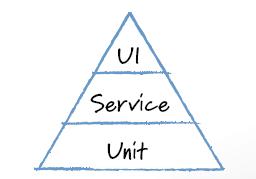
 Test Automation Pyramid by Mike Cohn
That model worked really well as it gave teams a shared mental model for how to think about confidence, coverage, and tradeoffs. It helped people stop writing brittle UI tests and start investing at stabler, faster layers.
But now that I work an AI agent and have to write tests for it, that pyramid no longer makes sense because agents change what “working” even means.
Traditional testing assumes that given the same input, you get the same output.
Agents break that assumption immediately.
LLMs are non-deterministic, and agent workflows span multiple steps, tools and extensions that live outside our codebase. So, sometimes the output is technically correct but still not quite what you wanted.
Trying to force this into strict pass or fail testing either leads to flaky tests or teams quietly turning tests off.
We needed a different way to think about confidence.
Test Pyramid for AI Agents
The biggest shift is that the layers are no longer about test types. Instead, they represent how much uncertainty you’re willing to tolerate.
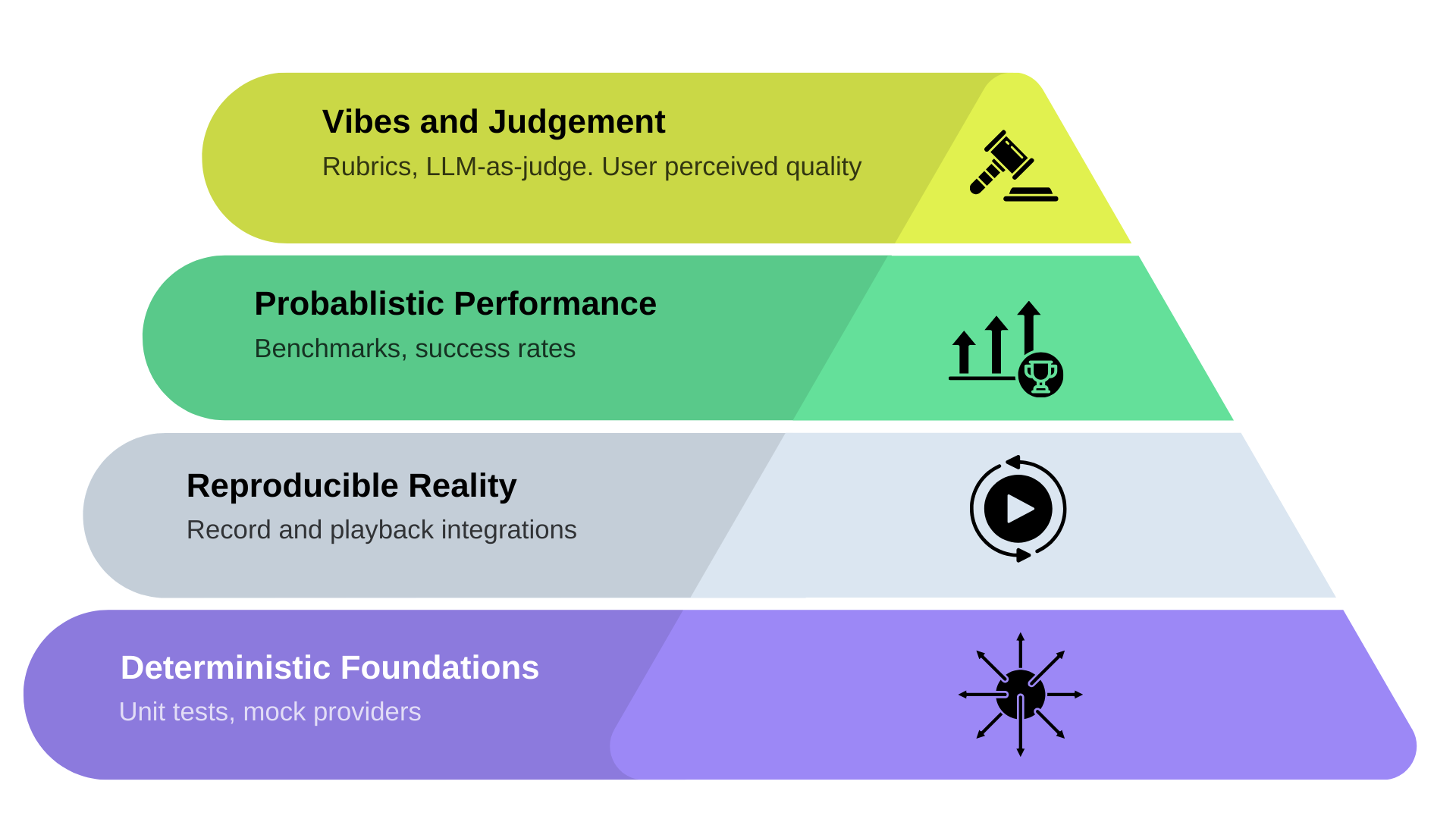
 Test Pyramid for AI Agents
Base Layer: Deterministic Foundations
At the bottom of the pyramid is everything that must be predictable. This layer answers a simple question: Did we write correct software?
We still rely heavily on traditional unit tests here. This includes logic like retry behavior, max turn limits, tool schema validation, extension management, and subagent delegation.
The key difference is how we handle the LLM. Most of these tests use mock providers that return canned responses instead of calling real models. That keeps this layer fast, cheap, and completely deterministic. It also lets us test failure modes that are hard or expensive to trigger with real models.
If this layer is flaky, we know it’s a problem with our software and not AI.
|
1 2 3 4 5 6 7 8 9 10 11 12 13 14 15 16 |
// Example: Mock that simulates an error impl Provider for ErrorMockProvider { async fn complete(...) -> Result<(Message, ProviderUsage), ProviderError> { Err(ProviderError::ExecutionError("Simulated failure".into())) } } // Example: Mock that returns plain text (no tool calls) impl Provider for TextOnlyMockProvider { async fn complete(...) -> Result<(Message, ProviderUsage), ProviderError> { Ok(( Message::assistant().with_text("Here's my response"), ProviderUsage::new("mock".into(), Usage::default()), )) } } |
Middle Layer: Reproducible Reality
This layer replaces classic integration tests.
Agents interact with external tools and MCP servers that evolve independently of our code. Mocking them entirely hides real behavior, but calling them live makes tests unstable.
So we record reality once and replay it forever. Funny enough, I used to warn against record and playback for testing, but it’s finally found its place.
In record mode, we run real MCP servers and capture the full interaction, including stdin, stdout, and stderr. In playback mode, those exact sessions are replayed deterministically during tests.
We are not asserting exact outputs here. We are asserting tool call sequences and interaction flow.
This lets us verify that the agent uses the right tools in the right order, and handles responses correctly without trusting external systems to behave the same way tomorrow.
We apply the same pattern to the LLM itself.
We have a TestProvider that wraps any real provider and can operate in two modes:
- Recording mode: Calls the real LLM, captures the request and response, and saves them to a JSON file keyed by a hash of the input messages.
- Playback mode: Skips the LLM entirely and returns the previously recorded response for matching inputs.
|
1 2 3 4 5 6 7 8 |
// Recording: wrap a real provider and capture interactions let provider = TestProvider::new_recording(real_provider, "fixtures/session.json"); let (response, usage) = provider.complete(system, messages, tools).await?; provider.finish_recording()?; // Replaying: no real provider needed, just the fixture file let provider = TestProvider::new_replaying("fixtures/session.json")?; let (response, usage) = provider.complete(system, messages, tools).await?; |
Record a good session, commit the fixture, and now we have a regression test that captures real model behavior at a specific point in time without mocking the content by hand.
This is particularly useful for testing multi-turn conversations where hand-crafting realistic responses would be tedious and error prone.
There’s a tradeoff though. If the model improves (which it often does), our recorded session won’t reflect that. But for testing our code’s behavior given some reasonable model output, that’s exactly what we want.
Upper Layer: Probabilistic Performance
Some agent behaviors cannot be validated with a single run. This is where we move away from assertions and toward measurement.
We run structured benchmarks that check things like:
- Did the agent complete the task?
- Did it select appropriate tools?
- Did it produce the expected artifacts?
These benchmarks run multiple times and aggregate results. Regression not longer means “the output changed.”, but instead “success rates dropped.”
A single run tells us almost nothing but patterns tell us everything.
Top Layer: Vibes and Judgment
This is the layer everyone has, whether they admit it or not lol. Agent output like summaries, explanations, research, and creative tasks simply can’t be evaluated with strict equality. So instead of pretending otherwise, we formalize judgment.
We use clear rubrics and another language model as a judge. Each evaluation runs three times, and we take the majority result to smooth out randomness. If all three scores differ, a fourth tie breaker round runs to force a majority.
So now subjective quality becomes something we can track and discuss. It doesn’t remove judgment of course; it makes the judgment explicit and repeatable.
The Agent Tests Itself
There is one more type of test worth calling out: first-person integration testing.
We have a smoke test that we can run ourselves where the agent validates its own capabilities end to end. It creates and modifies files, executes shell commands, discovers extensions, orchestrates subagents, handles errors, and produces a report.
The agent proves it can actually do the things we claim it can do.
If this fails, we know that something is really broken.
What This Changes About Testing
Agent testing is probabilistic. That part is non-negotiable. We cannot eliminate uncertainty, but we can manage it.
Instead of exact matches, we look for trends; and instead of pass or fail, we measure success rates.
But one thing we don’t do is run live LLM tests in CI. It’s too expensive, too slow, and too flaky. The benchmarking framework runs on demand, not on every pull request. This is a deliberate choice. CI validates the deterministic layers, and humans validate the rest when necessary.
Within the industry, testing feels a bit chaotic right now. But that’s because we are trying to use old mental models that were designed for deterministic software to test agentic products that are non-deterministic in nature.
The test pyramid has evolved. Once you accept that, testing starts feeling more familiar again.


Hi Angie,
It took me a few minutes of reading this to realize you weren’t talking about AI Agents as a developer tool (writing code) but rather AI Agents as the product interface.
When an AI Agents are the product / software interface you have a much more challenging problem because the interface itself isn’t deterministic – those agents can say many different ways what they did.
Great breakdown to managing that uncertainty.
Thanks for this. Really insightful.